|
|---|
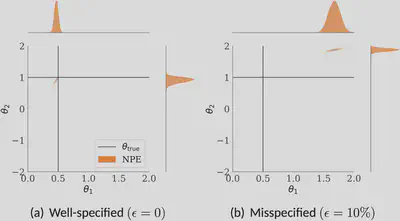
| Figure 1: SBI is sensitive to model misspecification. Here, model is misspecified due to contamination. |
Mechanistic simulations are used to model complex systems in research fields as diverse as genetics, epidemiology, geology and economics , for which explicit statistical models are challenging to express. In such simulator-based models, synthetic data are generated to represent the underlying real-world phenomena of interest based on our mechanistic understanding of the system. Unfortunately, standard statistical inference methods are poorly suited to simulator-based models, as their likelihood function—a quantity central to both frequentist and Bayesian inference—is typically intractable.
To address this issue, a host of simulation-based inference (SBI) methods have been developed that circumvent the need to evaluate the likelihood or its derivatives by relying on forward simulations from the model. SBI methods permit sampling from the approximate posterior by either comparing distances between simulated and observed datasets (or their respective summary statistics), or by training a conditional density estimator (typically neural networks) to approximate the simulator. SBI methods have led to significant advances in many scientific disciplines such as gravitational wave astronomy, particle physics, cognitive science, and ecology to name a few.